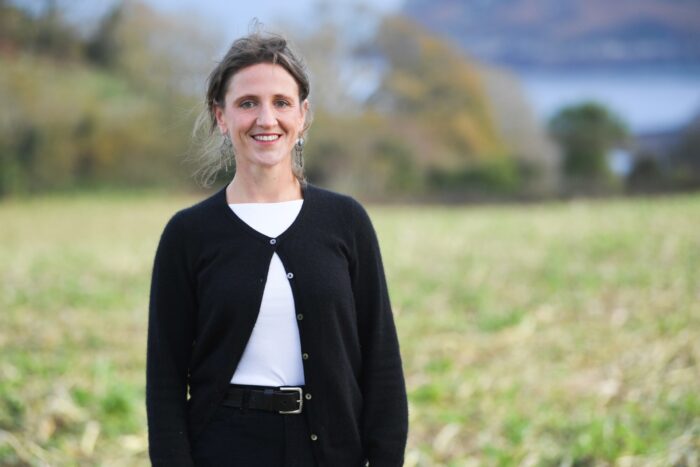
WE only have approximately five days food supply in the Island at any one time. What would happen if our food supplies stopped arriving? We talked to Taylor Smythe of Farm Jersey
If, for any reason, there were no ferry, be it for political, environmental, or even accidental reasons, what could we do to help ourselves to ensure better food security and to diminish the possibility of food deprivation — or even starvation?
These questions are asked by Taylor Smythe, the Local Food and Farming Lead at Farm Jersey, headed by John Garton, which promotes and encourages farming and local food production.
‘The question of food security has become urgent,’ Taylor said, ‘especially when considering the current war and non-cease fres and chaos in the Middle East. We have not even realised what the ramifications of this will be, but we know that 20% to 30% of fertiliser comes from that region. At the moment, the Straits of Hormuz open and shut as things veer from war to dimplomacy and back again.
‘We know that 20% of the world supply of helium, which is used in microchips in every smartphone, is also disrupted. Two-thirds of all microchips are produced in South Korea, and as of now, Korea has a severe shortage of helium. The price of diesel has doubled, and when you start to look at food, specifically global food production, we’re going to be in serious trouble if we don’t actually think about preparedness.’
Taylor quoted the Canadian Prime Minister, Mark Carney, speaking at this year’s Davos conference: ‘A country that cannot fuel itself, feed itself, or defend itself has few options. If the rules no longer protect you, you need to protect yourself.’
So, what can we do to protect ourselves?
‘The first thing is to know where we were, where we are and where we want to go. We used to have a thousand farms, and today we have only a handful of commercial vegetable growers in the Island.
‘In Ireland, for example, which has always had a huge agricultural sector, there were 400 to 600 commercial vegetable growers in the 2000-2010 decade; today there are only 60 commercial vegetable growers in the whole of Ireland. This is a declining trend that we see across Europe.’
‘The problem is that we import most of our food while local farms and farmers struggle to survive. People are not buying local food regularly enough. So, if there is no demand, there will be no farms. Apart from any other reason, that would be a catastrophe in terms of food security for Islanders.’
‘Think twice and buy local’… that slogan dates back about 15 years, but nobody has taken too much notice and we all continue to buy imported food from supermarkets. We buy everything else we need or want from Amazon, to the detriment of local businesses. Perhaps we should be paying more attention to that wise advice in this current time of international tension.
Does she think the present political crisis could just be a blip, and things might revert to normal in due course?
‘It’s absolutely not a blip! We can expect more wars, more conflicts over resources, and more geopolitical instability. It doesn’t matter if you are rich or poor. If you have money, but you don’t have the products available, what can you buy? Things will get worse long before they get better, unless people start to wake up.
‘During the Second World War, it was realised that there were only six weeks of food supplies left, because of the German U-Boat blockade, and that situation initiated the Dig for Victory campaign, when thousands of people converted their lawns to vegetable plots.
‘The War was a time when people were more patriotic and unified behind a shared common goal. In many ways since then we have focussed so much on individualistic goals and freedom that we have jettisoned a lot of what we did for the common good. And the things that are happening now means the world is just going to continue to get more unstable.’
Taylor continued: ‘Right now, we are definitely living in a bubble, and it might not feel like there’s any sense of urgency to be supporting local food production or growing food at home, but if you talk to anyone who works in supply chains or logistics or the food industry, they’ll tell you that by July those knock-on effects of increased diesel and fertiliser and feed costs will have impacts on the cost of food in the supermarkets. We are already paying 20% up to 30% more for our groceries in Jersey than in the UK.
‘People are really under pressure because of the cost of living. It’s so important to build or expand on what already exists in the Island. The fastest way to do this is to create consumer demand for locally grown produce, to signal to growers to take on an extra polytunnel, or an extra field, because there is local demand.
‘The economic reality is that 75p of every £1 spent on local produce stays in Jersey; as little as 10p stays from supermarket spending. Where we spend our money shapes the future of the Island.’
‘This is something we can fix together, if people buy local, if they visit honesty boxes, farm shops and farmers markets, if they support farmers regularly, farms will survive. There is a community aspect to this, as well: people need to reconnect with the land, and to each other.’
A vision of an Island community of smallholders and market gardeners might sound very appealing, but at present the agricultural industry is mainly export orientated — potatoes and dairy produce. Wouldn’t a recalibration of the industry to domestic production be an unkindness, to say the least, to the Island’s farmers?
‘No,’ she replied. ‘I think it would be of benefit to the Island. Large-scale export growers will see opportunities to grow crops for the local market. Think back a few decades and how many different crops were grown in Jersey. It isn’t economically feasible to export these products, but think of the possibilities of growing these for the local market. How do we build resilience and efficiency at the same time? There is a local demand, and there are plenty of outlets that want to be buying local. So: support growers, find a farm, buy local, cook what grows here, embrace seasonality.
‘This isn’t about export versus local; the goal is to make buying local food a normal weekly habit across Jersey. And this is not about creating something new, it is about using what we already have before it disappears.’
‘People want to feel good about their choices and take a lot of pride in Jersey. Supporting local farms and food production is vital to the Island’s food security.
‘We need to keep Jersey farming, and how do we bring it back into people’s focus?’
She answered her own question: this summer there will be a launch of Jersey Farmers Markets, beginning at the RJA&HS Summer Show (13/14 June) and ending at the Autum show on 4 October. In between, there will be a Farmers Market every other Saturday at Le Tacheron Farm, Trinity, between 10am and 2pm from June to October.
‘We want to encourage all growers and producers, however big or small, to join us. Freshly baked bread, good coffee, hot food, fresh produce and flowers, live music and activities for the children, so people can bring their families. We are inviting different chefs to come, and to demonstrate making a different meal with the products that are available on that day at the market. We hope this will encourage a culture that really celebrates all that Jersey produces.
‘The ambition is to introduce more people to local producers and their products. Next year, as demand grows, we could also have farmers markets in town on a weekday. These will be in town one week, and then in the country the next week. We just need to make people more aware of what is available and how much better fresh from the farm does taste. The kind of food you can feel really good about buying and preparing for your family.
‘A little local goes a long way—and we need to keep Jersey farming, for our own benefit just as much as for farmers!’