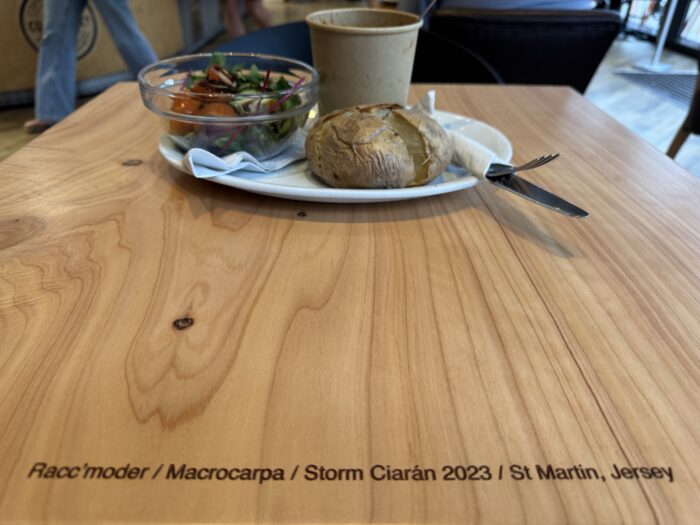
The picture shows a table delivered recently to Cooper’s coffee house at Castle Quay.
It is not just any old table – it was made from a tree that came down in the storm in 2023.
With the help of Xanthe Hamilton and Acorn this tree has journeyed from St Martin to storage in St Lawrence, turned into planks that have been cut and sanded by Acorn, and finally delivered to Cooper’s.
Business owner David Warr said that he intends to replace all the tables over the coming year with the wood from this storm.
The back story (republished from the JEP, with their kind permission):
A couple of days after Storm Ciarán had done its worst in early November 2023, there was an opportunity to drive out to see how the countryside had fared; it did not look at all happy. It was not so much bruised and battered; rather, it was the ravished victim of a violent rape by a brutal and devastating tempest. Tree trunks that should have proudly borne aloft a canopy of green, now ended with a raw and jagged stump, with their upper parts collapsed and trailing on the ground.
Ciarán is history, but recently we have had Storm Darrach, in which trees also fell and inevitably there will other storms in the future. It hardly needs to be said that trees are also felled intentionally through human agency, for right or wrong reasons.
Xanthe Hamilton has founded Racc’moder, anenterprise to utilise fallen timber for local use. She said: ‘I just felt it would be such a shame, if all these amazing trees, that had taken many decades – if not centuries – to grow, were just cut up for firewood.’
And Racc’moder means…? ‘It is a Jèrriais word, which means ‘to mend’but also to remodel, make new, repair, revitalise, or regenerate. I love this word, because I don’t think we do this enough. We just throw away and buy new. Racc’moder stems from a time of making do and mending. For example, in some old Jersey houses, the beams would have been made from old shipping masts.
‘I was thinking we could bring this word alive, by tackling old buildings and renovating them as a cooperative.
‘You can racc’moder anything, really. You could racc’moder your soul, or your health, or your relationships,or the natural environment, or a nation state might racc’moder its society. I love the fact that the word is uniquely Jersey.’
The best thing to do with a fallen tree is to leave it in situ. It moulds down, and eventually disintegrates, and that process is good for biodiversity. Nevertheless, it might be seen as being messy and ugly,or just not possible or practical. So, if it is going to be cleared, why not use the wood for a useful purpose, rather than just letting it become firewood?
Xanthe said: ‘I was not too interested in wood. But I am interested in doing things that are not being done, and I do have an interest in environmental innovation. Yes, there are other people milling fallen trees, but I just want it to be the default reaction that when you lose a tree, you mill the timber and it goes into the local supply chain.
‘That would certainly make sense, especially with the increasing price of timber and the cost of importing. Otherwise, you don’t know where the timber has come from; it might not be ethically sourced, especially as it’s imported in container loads every day.
‘But there is no reason why we couldn’t be using our own timber,innovating a local economy, and developing skills around transforming timber into the products we are commonly purchasing — and it’s not just load bearing beams, either. Every household possesses multiple items of wooden furniture.
‘There is this mentality that a fallen tree is only really good for firewood, and that mentality is a real shame.’
She continued: ‘I am trying to make an opportunity out of a disaster. Storm Ciarán was a disaster, so how do you create something positive out of that? And, speaking more broadly, how can we respond, as an Island, to disasters? Because storms are going to keep coming. We should be agile, as a small island — more agile than a larger place might be.’
At La Collette, there were literally hundreds of tons of waste timber, and Xanthe was told to come and take what she wanted. She arranged to pick up 70 tons.
The key piece of the missing infrastructure for Racc’moder was a wood mill. There is another wood mill in the Island and many tree surgeons own chainsaw mills. But, to have a real impact, Xanthe hopes more of their customers will request that timber is milled, and she hopes to help generate a more accessible market place for that timber.
She went to Dorset and Devon to look at different wood milling and timber innovation locations, and she was recommended not to hire a wood mill in England to be sent to Jersey, but to buy one, and a wood miller would come over and train local people how to use it.
So, they managed to buy a mill, and training was arranged for Racc’moder’s employed carpenter, Dan Davies, to use it. Since then they have been practising, converting timber to floorboards, beams, and big slabs for counters, just to see what they can do with the raw product at their disposal.
Drying timber so it can be used for furniture or fittings is a slow process – once milled, the rule of thumb is that one inch can be dried in one year through air drying. But that fits quite well with major development projects, which generally are planned around two years before building starts. Also, drying wood in a kiln accelerates the process, Racc’moder already has a small kiln which can speed seasoning time to three to four months.
About 40 trees have been milled so far: ‘We are slow at milling, as already we are being asked to make crafted objects with our wood. As we only have one member of staff and one apprentice, there are not enough of us really, both to operate the mill and to convert the timber into items for domestic use or for the local building industry. Racc’moder is still a new enterprise, so we believe this is a good problem to have.
‘What I was excited about, Xanthe continued, ‘was that we had all this storm timber and we could do something quite radical with it. But then, I thought: we really could do with some big building projects, because it would be so nice to commission an architect to design ten affordable houses and use as much storm timber as possible in their construction.
‘The wood doesn’t have to be structural timber; it could be kitchen worktops, or flooring, doors, bannisters, doorknobs… I thought: wouldn’t that be a wonderful project? So I set about setting up the Community Land Trust. We are looking at three different sites that could be community hubs or cultural centres, and for which we could use large amounts of fallen timber. This could be an even more ambitious outcome.’
The Association of Jersey Architects has engaged with this project, and Romerils has part funded the cost of the mill. ‘I am being asked all the time for quotes; architects want to do an experiment with cladding and other innovative timber products, and they are finding their clients are positive about incorporating local storm timber into designs.’
She hopes to hire out the mill, to make milling more accessible as well. It can be hitched to a car and taken anywhere.
‘There has been a real sense of people wanting to see Racc’moder happen. The material we use is very tactile and very natural – and I prefer handling it to handling the synthetic surface of my computer keyboard!
‘A lot of people love trees, so it has been quite easy to get support and commissions, because people want their story in their lives. Waste wood has a special meaning for them. People do want it – it’s not a hard sell! And we shall always have a supply of raw material: trees are felled not only from storms, but to make way for new developments, and also as management of woodlands.’
Readers may remember Xanthe’s name in connection with the Branchage Festival, of which she was the driving force, working from a London office in Bethnal Green, and, in her words, ‘fusing Jersey and London cultural life’. She has now returned to live in the Island where she grew up.
The Community Land Trust that she has been instrumental in founding, is a not-for-profit organisation that is run by the community to deliver building projects, such as affordable housing, a cultural venue, a farm – the ownership is with the community and they make the decisions, with the community acting as a developer.
‘It is run by a voluntary board, and membership is open to anyone interested. It is all about people doing their own “regeneration” of community life. You can get really good results when people do that, because they are super passionate about what they are going to deliver.
‘It’s not about the bottom line, it’s about how great we can make this for our community.’