By John Michel, ‘Tree Advocate’ for Jersey Trees for Life
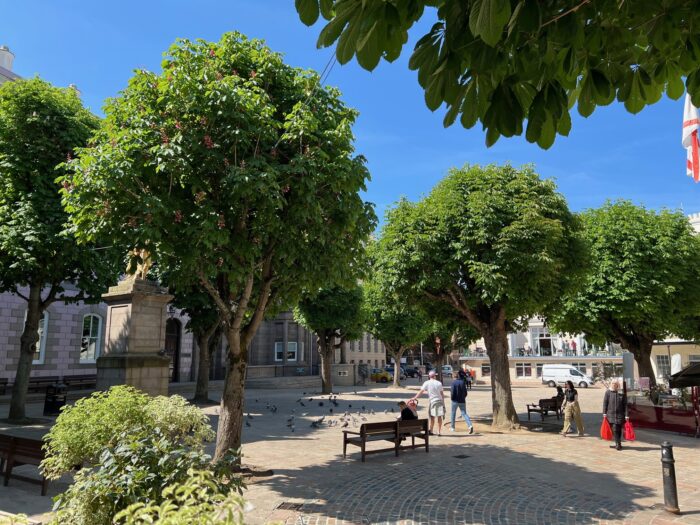
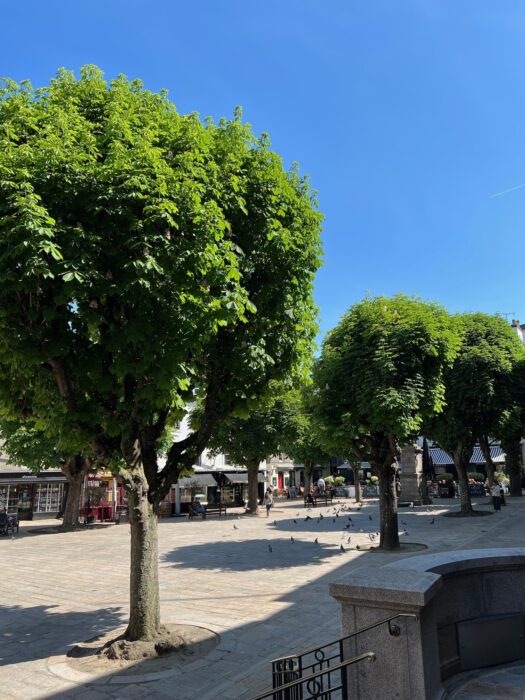
Around the Royal Square’s edge stand eleven horse chestnuts that are part of St Helier’s identity and among Jersey’s best-known trees. Indeed they’ve been around longer than any of us, having been planted in 1894.
The Royal Square, known then as Le Vier Marche or Le Marché, was a different place in Victorian times, used not only as a market but also for announcements and even executions. Moreover, St Helier was, in Jerripedia’s words, “considered an insalubrious urban wasteland… no respectable person lingered after dark as prostitutes from the ends of Town drifted in… to ply their trade in the shadows”. Quite the endorsement.
It was before this social backdrop that the Constable of St Helier, Philippe Baudains, persuaded his fellow Defence Committee members to adopt an act allowing tree planting in the square. Citing necessity due to paving-based safety issues, his motion passed by the odd vote.
Naturally, pushback proliferated as natives feared a range of problems. At one end were matters like roots damaging buildings, foliage blocking light and wind whistling through leaves. At the other were concerns about encouraging prostitutes and, best of all, looking too French. Zut alors.
Once agreed, the plan was to plant 24 trees, with the Constable deferring species choice to his peers. The Deputy of St Saviour’s equine preference prevailed.
Planting started on 9 February 1894 with ten horse chestnuts from Becker’s nursery, each 20 feet high. The second row (along Vine Street) followed a week later. Today, the first batch are going strong, veterans of major weather events, whereas only one other remains, due to development. These days the survivors are pruned to 7.5 metres every five years.
Horse chestnut is part of the Aesculus genus (Sapindaceae family) found in the temperate northern hemisphere. Although common locally, our species has Balkan origins, which helps explain its Latin name, A. hippocastanus, being partly Greek (hippo-horse). It came to Britain about 400 years ago.
These trees are a rich source of nectar and pollen, with conkers used in medicines, additives, detergent and playground games. It’s easily spotted, thanks to its spiked green husk, big droopy leaves and white candle-like flowers, as is the red-flowered variation (A. x carnea), a red buckeye (A. pavia) hybrid.
Finally, horse chestnuts are mighty trees, capable of growing to 40 metres and living an impressive 300 years. At over 130, perhaps our chestnuts aren’t that old after all.