Is Jersey ready for a farming revolution?
The potential of citizen-owned farms was explored recently at the Regen Gathering at Le Tacheron Farm, in Trinity.
No red flags were raised, but the idea may have sown a seed which many hope will lead to far-reaching change.
The movement has certainly started elsewhere.
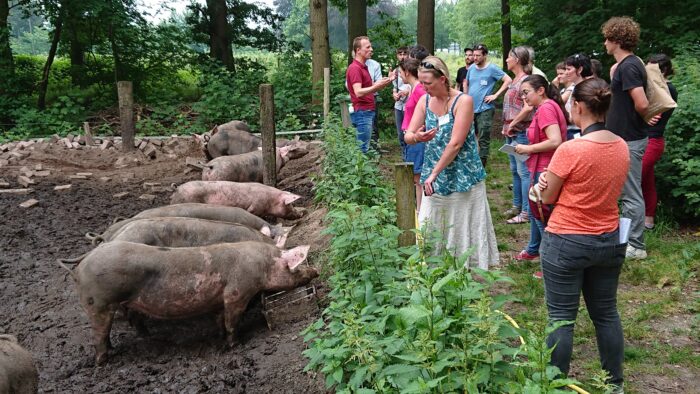
Guest speaker at the annual event Douwe Korting shared his experience of co-operative farming in the Netherlands.
He is pioneer of the ‘Herenboeren Farm’ (People’s Farming) concept.
“It is more than farming, it is a community,” he said. “We think it is a good way to stay connected to the farm and to the land, — and to the farmer. And for consumers, the journey time of produce is two hours at the most from the soil to the kitchen.”
Douwe, pronounced Dower, has a background in international land and water management and in farming journalism.
In Herenboeren, 200 to 250 households have come together in a co-operative that hires a farmer to produce their food. The households share costs and all other benefits of their regenerative farm, including produce and the fun of being part of a farming team.
There are now 26 Herenboeren farms across the Netherlands, with around 10,000 people receiving produce from them.
Douwe explained that farmland was as expensive there as anywhere else, with an acre of agricultural land costing between £40,000 and £70,000. Labour is also expensive.
He told the Jersey audience that farming was not profitable. For every £10 spent by retail consumers, some farmers only get £1.
There are also environmental problems, such as safeguarding biodiversity and water quality in densely populated areas. Livestock farmers have been urged to reduce the numbers of cows and pigs.
Feeding of the 500
The first community co-operative farm was established near Eindhoven in the south of the country in 2016. It was a 20-hectare mixed farm supported financially by 200 households which could feed about 500 people.
The financial backers were effectively shareholder investors, sharing the capital and operating costs such as irrigation, electricity and soil improvement.
The contribution was set at approximately £1,800 per contributing family. The farmer, the person doing the daily physical work of farming, is paid £2,500 a month. He is assisted by many of the co-operative members who volunteer for planting, harvesting, weeding and generally helping the farmer. There are therefore no labour costs.
Members share all the costs and all the yield. The rules state that no produce is sold into the food chain, everything is distributed among members. Any seasonal glut of produce is converted into food that can be kept – fermented, put in the freezer, made into chutney and so on — so the summer harvest can be enjoyed in the winter months.
‘It’s not the farmer who decides what to grow,’ Douwe said. ‘If the community want potatoes, he will grow potatoes. If they don’t want onions, he will stop growing onions, or produce more beef or less beef, just as the community wants. It’s the community which decides what to grow.”
He added: “Quality comes before quantity — quality of the soil, quality of the water, quality of the food, quality of the natural environment, working life, quality of the entire system… quality is the important issue, and is at least as important as the quantity of the food grown.”
In the long-term, the co-operative aims to be self-sustaining, with no need to purchase seed or feed from outside the co-operative.
But could citizen farms work in Jersey?
“Yes, I think it could work,” Douwe said. “Exporting early potatoes is a good business model, but all the other fresh food and vegetables are imported. It would be better for the Island to grow more of its own, and to be more resilient against climate change or any disruption to the supply chain. It would be good for the soil as well, if a more diverse range of crops were produced.
“People have to eat every day. It’s a very intimate activity; you put something in your mouth, the food travels down inside you and becomes part of you. You should look after yourself, and not just buy industrially made, imported food from the supermarket.
“You should take more care of your food, and in this way, take better care of yourself.”