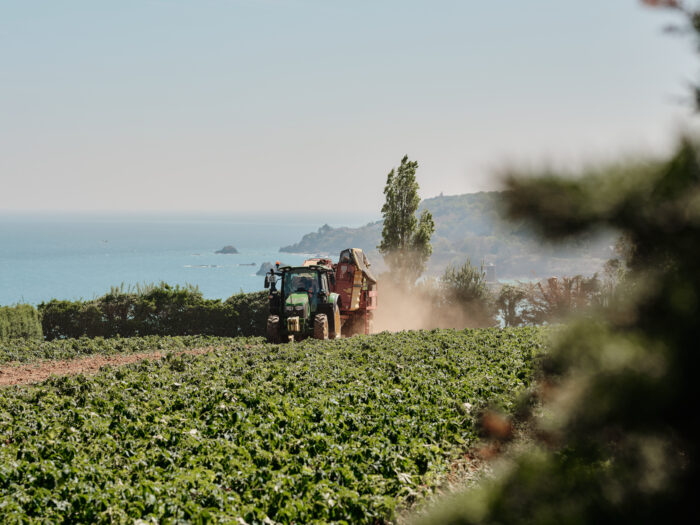
Food security is no longer a theoretical issue for the Island, it is a strategic priority, the Assistant Minister for Environment, Agriculture, and Fisheries has said.
Deputy Kirsten Morel stressed that the Island had to increase local food production.
He has been working with the agrciultural sector for a number of years, and successfully secured ongoing funding in the States for farmers and fishers. That money has helped to improve resilience in the face of climate change and other threats.

The challenge of wetter winters and drier summers is being compounded, he said, by the risk of supply-chain disruption and cyber attacks.
‘Around 70% of the world’s food is produced by just 15 countries,’ the assistant minister explained. ‘When production is disrupted in a relatively small number of locations, the consequences are felt across the world.’
He added: ‘For Jersey, these issues are particularly important. The United Kingdom produces around 65% of the food it consumes. Jersey’s figure is considerably lower; I think it sits near 10%.’
The assistant minister made his comments at the recent Jersey Farming Conference.
‘We should be asking how local production can complement imported food, how supply chains can be strengthened, [and] how we can ensure that future shocks have less impact than those we have experienced in recent years.’
He added: “There is significant potential to increase the role local produce plays in feeding the Island, and in so doing, it will strengthen the Island’s resilience.”
Deputy Morel argued that investing in and supporting local producers was not just common sense in a volatile world, but it made sound economic sense too.
Islanders spend approximately £230 million annually on food, he said, and much of that left the Island.
‘Every additional pound spent on local food helps strengthen local businesses. It supports local employment, keeps money circulating within our economy, and contributes to the resilience we are seeking to build,’ he said, adding: ‘Success depends not on avoiding uncertainty, but on your ability to adapt to it.’
And the Deputy dismissed the idea that higher prices for locally-produced food would always put people off, suggesting the fact that people regularly paid slightly more for Jersey eggs was a case in point.
Over the past seven years, government support for agriculture has increased from £1 million to £10 million. That money has helped enable farmers to invest and explore new opportunities.
Deputy Morel said that smallholders had a particularly important part to play in the evolution of the industry, as they could experiment and try different ways to do things.
‘The idea is that [what they learn] can be passed on to commercial growers,’ the assistant minister said.
In April, Chief Minster Senator Lyndon Farnham said that the Island’s supply chains remained secure, but accepted that Jersey was susceptible to global events.
The issues were, he insisted, being kept under constant review by the Emergencies Council.
Brigadier Nigel Hall, who has been an outspoken critic of what he alleges is the government’s lack of focus on emergency planning and resilience, has called for a system-wide recalibration.
“Resilience is very different to ‘normal’ emergency planning and risks. It is about whole-of-society prevention and preparation, and getting ahead of known serious risks,” he said in a letter to the JEP.
“There are acute resilience vulnerabilities, eg food and energy supply.
“There are quick-into-action and relatively cheap mitigation measures to address such risks – simply increase days of on-Island food supplies and diversify energy sources.”