Recently, Islanders have been able to visit St Helier Methodist Centre for a lunar experience. Setara Pracha was impressed
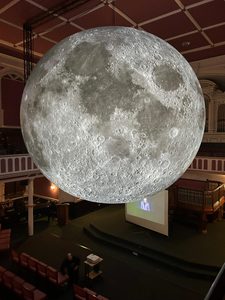
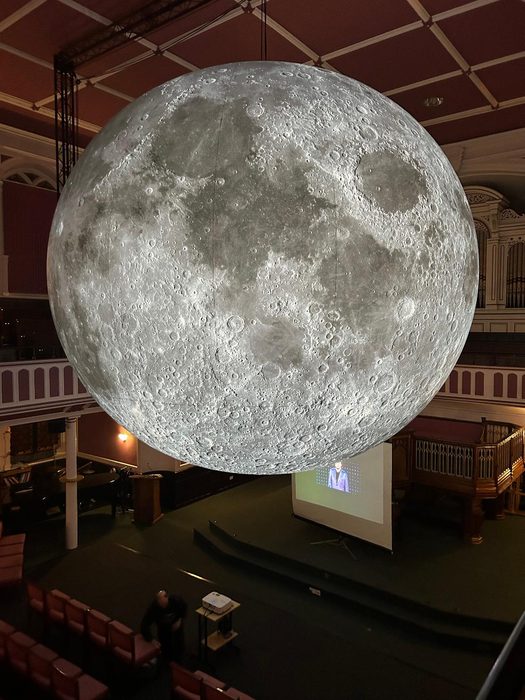
If you stayed up to watch the Artemis crew encircle our nearest neighbour, remember the Clangers, or simply love cheese – the ‘Museum of the Moon’ is for you. This illuminated sculpture is 6 metres of detailed NASA topography, is lit from within, sways slightly and has been hanging in St Helier Methodist Centre.
The dark side is light. Awe and wonder fill me with unshed tears at the scale, the complexity, the fact that this is as near to the moon as I will ever get.
Buzz walked on its surface in my birth year (cue Bryan Adams song -‘Summer of ‘69’).
Beauty is not enough for us: humans are curious monkeys who enjoy working things out.
There is a lecture and I am expecting lunar facts. The Prof is eloquent, erudite, educated. He is an astrophysicist and a theologian, and, as a Methodist preacher speaking at this Church is a joy. Reverend Professor Stephen Wilkinson speaks of science and faith, questioning why they are seen as exclusive, a reductive position which he knows holds western knowledge back.
I find myself silently nodding, for me the big topics are inextricable, theology and philosophy and art and science are friends at my supper table, I cannot dance with one without skipping with the other.
Instead of sitting underneath the orb I stay on the gallery, silently communing with the three-metre installation, using a map to find my way around the lunar landscape, so familiar yet so alien.
The Prof begins by referencing Hitchhikers, that long-shadowed jokey novel by the late, great Douglas Adams. I bought the series again recently to reread, our sober times demand silly responses and Adams was very silly. I learn that it is 240,000 miles to the moon but takes 13.4 billion years for light to reach us from distant galaxies, yet just 8 minutes for the sun’s rays to arrive on planet Earth. The Prof shows us universe simulators on a screen, the elegant unfolding of the Big Bang in miniature, the ‘God Particle’ caught in experiments in laboratories. It is uncomfortable to see it trapped in a glass box – it is clever, but is it right?
‘Gibbous’ is Middle English for ‘hunchbacked’, the moon as somatic. The figurative language hidden in the scientific lexicon reveals our awe.
It reminds me of my gasps of joy last Friday when Dr Robin Catchpole showed us solar flares pirouetting through space. This was an Astronomy Club event and I did my best to keep up as another proper science nerd juggled eons of time on a cosmic scale. It was an unsettling wander through climate change and I reflected just how little humans know about the world. When we look up at night, we look back in time to stars which may no longer exist. If you want to get some perspective on your life challenges, go outside on a clear night and look up.
Scientists remain foxed by the universe and can only grasp the components of 5% of it, the other 95% is a mystery. What is dark matter? What is dark energy? Will there ever be a quantum theory encompassing gravity, and if not, what are the theory’s limits? Alas that Stephen Hawking went on his final journey without finding the answers. For some folks God is the intelligent watchmaker, the designer of the Goldilocks Enigma Theory, in which everything is in the anthropic balance which is just right for carbon-based life forms (us). I listen, wondering why we need a deeper story and decide to cultivate ‘not knowing mind’: how can a God this great be known?
I linger on the balcony, close to the Moon’s sphere and allow my mind to wander. Ahead is Copernicus Crater, Kepler’s to the left, the Mare Cognitum – ‘the sea that has become known’ (this makes me laugh), the Sea of Clouds and the Sea of Tranquillity soothe my heart. Someone points out where the astronauts landed, at what I surmise is the nearest point to Earth. I swim in the Sea of Serenity and marvel at Creation.
Christians say, ‘In the Beginning was the word and the word was with God, and God was the word.’
Muslims say, Allah said ‘Koum’ and the world was made.
I say, ‘well done Mother Nature, Father God, or whatever, your cosmos is great work’. The final words are from Galileo Galilei, whose scientific ‘heresy’ of 1616 was being reconsidered by the Church as late as 1992, when an accord was finally reached.
‘The Scriptures tell us how to get to Heaven, not how the Heavens go.’