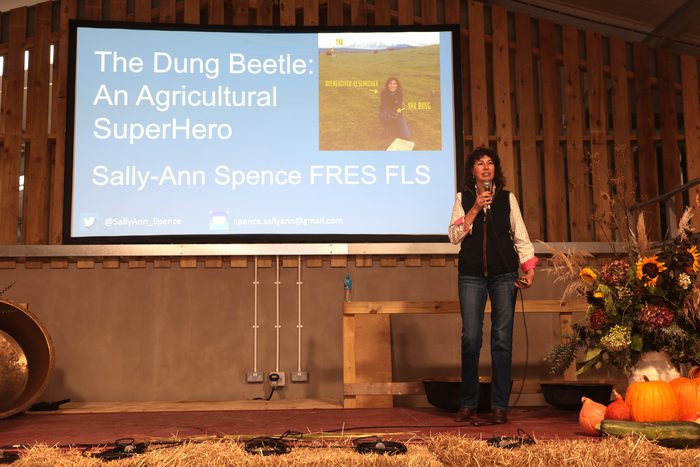
‘MEET your dung beetles….’ that was the invitation to the audience at last week’s Regen Gathering, by invited guest speaker Sally-Ann Spence, who gave the first presentation to Regen on the Friday morning.
Sally-Ann Spence is a scientist, presenter, farmer, entomologist and a Fellow of both the Royal Entomological Society and the Linnaean Society. In 2024 she was awarded the British Entomological and Natural History Society’s gold medal for decades of promoting dung beetle awareness, and for her research into dung beetles and the livestock sector.
It was nice of her to want to introduce the audience to their dung beetles, but did the audience really want an intimate introduction?
‘I’m a passionate advocate of British farming and biodiversity,’ she said, ‘and I do a great deal of scientific public outreach at my own educational research centre, Berrycroft Hub, which I own and run, where I have both cattle and sheep that manage all the grassland. I also lecture in colleges, universities, museums and at various events around the UK.
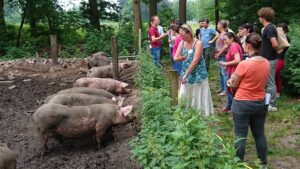
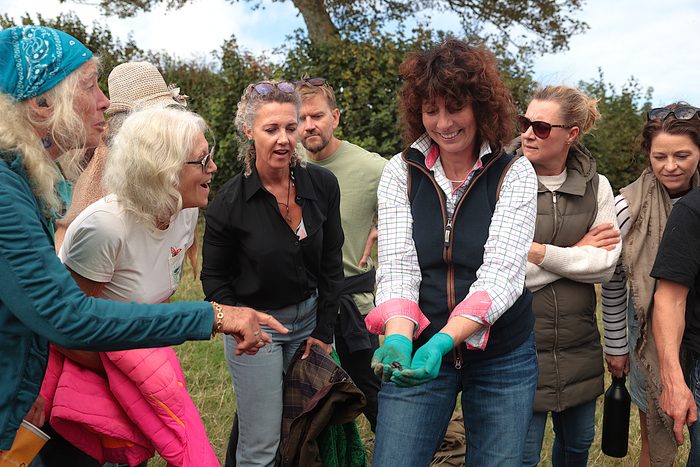
Apparently, they did, as over the two days of Regen she led two ‘dung beetle safaris’ to one of Le Tacheron Farm’s fields, and these two safaris attracted sizeable crowds. If the truth be told, it was probably not just the beetles that attracted so much attention, as Sally-Ann’s gift of relating to an audience and making the subject interesting, amusing and relevant.
‘I am slightly obsessed with insects! I can be found discussing dung beetles on radio and other media platforms, including television.’
Incidentally, she has recently won ‘Britain’s Got Talent’ as a member of the Hawkstone Farmers Choir.
So, back to beetles. What are the benefits of having dung beetles – and why are they so important?
‘They are ecosystem engineers. They are bio-indicators; they increase the biodiversity both above and below the ground. They do a phenomenal amount for soil health, and they help our soils be more resilient to climate change as well. They also help suppress parasite burdens in livestock; they increase the pasture quality, they help to sequester carbon, reduce methane… the list just goes on and on and on.’
Dung beetles, it seems, are definitely the good guys. What is the state of the dung beetle population in Jersey at the moment?
‘I am very pleased where we are today, because what I’m seeing at Le Tacheron is a good abundance of beetles, although it would be better to see a wider or a longer species list. And so, I would like to come back – it was 2019 when I was here last, to properly observe dung beetles in Jersey, and we did not quite get a complete data set. It would be nice to complete that data set and do a comparison with 2026 to see how the dung beetles are doing.
‘Are they doing brilliantly? Better than before? Saying at the same level, or reducing?… and how can we implement management plans to increase the population, as that would only have a very good effect on the wider environment?’
Sally-Ann specialises in dung beetles and pastureland biodiversity. She founded the UK Dung Beetle Mapping Project (DUMP) accumulating species data. Her work with the project saw her surveying field sites all over the UK, and many outlying islands, including Jersey, of course, which enabled her to study a multitude of grazing systems.
This practical experience has been translated into collaborative projects, working on sustainable land management plans within the farming community to promote dung beetles as important bio-indicators for soil, pasture and livestock health.
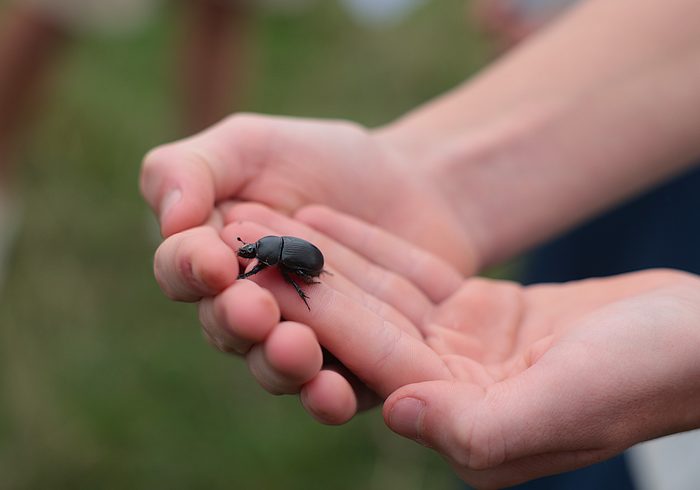
And what does Jersey have that the UK does not? Various answers might spring to mind, but in this instance, the correct answer is that Jersey has the horned dung beetle – Copris lunaris – which is extinct in the UK (or at least, last seen in 1974). This is a remarkable, heavily built black beetle famous for the large, backward-curved horn on the head of the males, which closely resembles a miniature rhinoceros horn. It is active on the Continent, and she was made aware – through social media – that Copris lunaris was active in Jersey, So, she was very keen to come over to the Island and see it live.
‘It was very exciting! But to get here and study it I jumped on the back of lots of different projects until eventually I got funded by Jersey to come and do a proper survey and help curate the Island’s beetle reference collection, which could be used by future generations and be used as a baseline. But it’s not complete.’
Entomology has always been a passion of hers, starting as a childhood obsession when she was growing up on her parents’ mixed farm in Suffolk, an obsession that has never left her:
‘I never grew out of it, sticking sticks in poo, and turning logs over and all that sort of thing. I was very lucky to grow up on a farm; I had a feral childhood, where I was lucky to be able to just run round and amuse myself if my parents were busy on the farm.
‘For me, I was just obsessed with nature, and the natural world, and insects in particular. You can just study their entire lives in miniature and their interactions with each other, and the environment around them, and they just fascinated me, and they continue to fascinate me.’
She went to agricultural college, married an arable farmer and then took on her own land on the Wiltshire chalk downs, which she has made her base.
From agriculture her interests broadened into entomology, and now she is involved as well in archaeology, palaeontology and geology.
‘All these things are connected, because I look at grazing systems that are pre-farming, and so I look at animals moving through the landscape, and their interaction through the landscape post the last Ice Age.’
She said she was very lucky, and honoured, to be invited to look at some of the invertebrates that were in the mass of coins and clay that formed Le Câtillon hoard, the world’s largest collection of Iron Age Celtic coins, gold, silver and precious jewellery, which was discovered in 2012 in a Grouville field.
‘Examining them give some idea about what species groups they were in, and to understand how they are there and what they would have been feeding on. They tell us a little bit more about the local environment at the time when the hoard was buried, and the site seems to have been wooded.’
She was also involved in the outreach programme for schools for Jersey’s Ice Age project, the major, long-term archaeological and geological initiative that investigates Jersey’s deep prehistoric past, exploring how the landscape and its inhabitants had evolved over 250,000 years of climate change.
‘You have such wonderful archaeology in Jersey,’ she said. ‘Jersey has everything – and rare dung beetles as well!’