By John Michel of Jersey Trees for Life
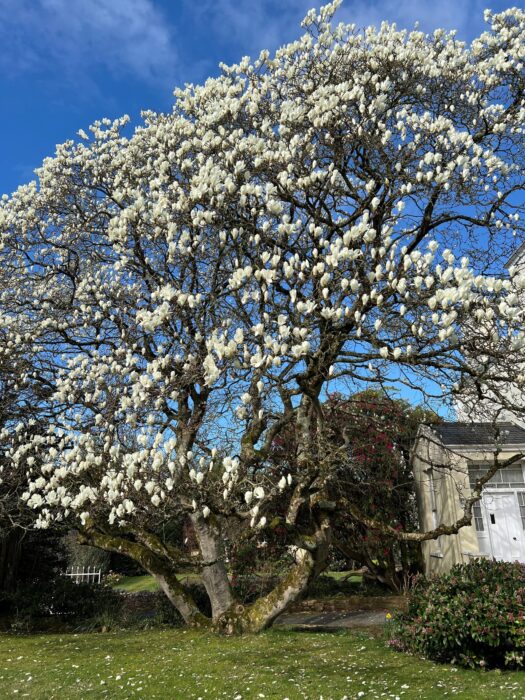
If you’ve been past Greenhills Country House Hotel in St Peter lately, you’ll probably have spotted the explosion of white at nearby L’Aleval House. For longer than most of us can recall, this glorious magnolia has been reminding locals and visitors of nature’s stunning beauty every spring.
The tree’s precise origins remain uncertain but it was mature when the current property owner, Pam Scragg, moved to Jersey in 1976. It was recently estimated to be about one hundred years old, so should be in its twilight years. Healthy specimens can live far longer, however, and this is in a sheltered, south-facing spot with moist soil – prime conditions to thrive. There’s life in the old mag yet.
Ms. Scragg said the magnolia’s aesthetics were a “huge part” of her decision to buy, adding that friends often drop by for a viewing and sometimes newlyweds even pop across from Greenhills for photographs.
This sentiment is unsurprising given magnolia’s striking beauty; its spectacular bowl- or star-shaped flowers have captivated gardeners for centuries and since the 1800s locally when first imported.
In the northern hemisphere most magnolias are deciduous – a function of climate. Evergreen exceptions include the southern magnolia (M. grandiflora), native to the south-eastern U.S. but familiar to us ornamentally.
Identifying magnolia is notoriously tricky due to hybrid numbers, largely through cultivation. In fact well over 200 species exist, including two discoveries in Honduras in 2023, a reassuring thought when half the world’s wild magnolias are endangered. This problem is acute in China and Vietnam where illegal logging and changes to land use (e.g. rice, cardamom) are rife.
Magnolias began evolving before the advent of bees around 100 million years ago and we know that plants in the Magnoliaceae family (magnolias and tulip trees) existed then. Beetles are the missing link. These unsophisticated pollinators crawl into the flower, bite indiscriminately and get covered in pollen before moving on, often trapped inside overnight. Simple but effective.
Magnolias also provide food and shelter for birds, mammals and insects. The bark and flower have been used for centuries in traditional medicine and can be found today in medicinal supplements and skincare products.
Culturally, magnolia can represent perseverance and dignity, purity and nobility or beauty and resilience – think Steel Magnolias and its strong women, set in Louisiana where it’s the state tree. Locally we echo this association with the L’Aleval House magnolia as a perfect example.