
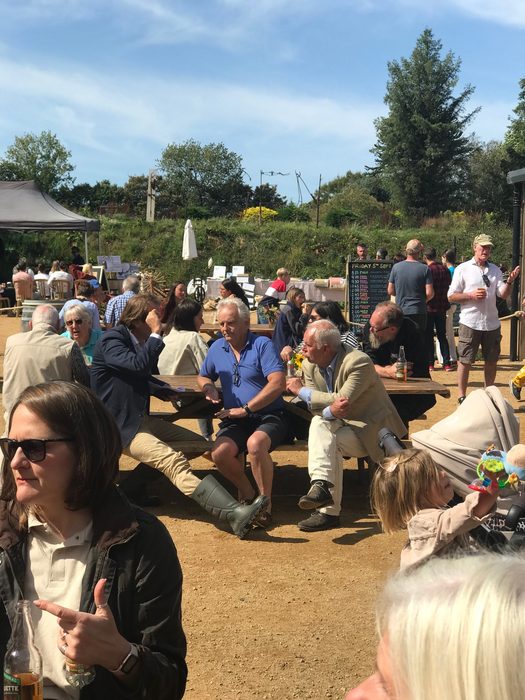
REGENERATION – that is the theme of the event being held on 11 and 12 September at Le Tacheron Farm, Trinity, and specifically it is about regenerative food and farming, a concept about which we hear more and more these days.
The event is called Regen Gathering 26, and it is similar to and inspired by the much larger Groundswell Festivalevent in the UK, which has been called ‘the Glastonbury Festival of farming’.
The Regen Gathering in Jersey is now in its fourth year, and has become an annual festival, focussing on farmers and health and the links that should exist between farming and finance. It is a forum for farmers, and anyone interested in food production or the environment to learn about the theory and practical applications of ‘conservation agriculture’ or regenerative systems.
As always at Regen, there are panel discussions, talks, workshops and technical demonstrations on a wide range of loosely connected subjects, with an over-arching theme of rethinking how to approach changing our food, farming, healthcare systems and market conditions to value the best agroecological farming market conditions.
The Regen Gathering includes a very wide of related subjects, but in short, it is where agriculture meets the environment – ‘agroecology’.
In essence, it is all about building a rural community and inspiring hope and optimism and imagination. It’s about getting people excited about reconnecting with the land and the opportunities and potential that might exist. The concept is a vehicle for people who don’t have access to land, for people who are new entrants, and who would like to farm but don’t come from families with farming backgrounds.
All the time, in all the talks and presentations, the unspoken theme is the regrettable atomisation of the rural way of life – in all spheres of life, actually – and what might be done to make the rural community a real and viable community once again. Society and social relations seem to have lost their way. People are meant to live in community and to work together, and that sense of community needs to be … well, regenerated.
The same concepts are embodied in the name of the location (and its story) where the gathering is held – Le Tâcheron Farm, in Trinity.
The name ‘Le Tâcheron’ is an old Jersey word meaning ‘the team’ – the ideal potato harvesting team of three people, each one of them with a specific role. Jersey’s success in agriculture has always been built on teamwork and for the owners of Le Tâcheron Farm, the word symbolises the relationship between the farm and the environment, the farmer and the community, the ploughman and his horse – in other words, ‘the team’.
But it could also just as easily represent symbiotic relationships between the soil and microorganisms, and, in many respects, the synergies encapsulated within the meaning of the word Le Tâcheron: literally, at the very roots of regeneration.
And Le Tâcheron Farm? Well, there’s a lot of regeneration in that, as well. There are not many farms, these days, that one can say ‘are new and are built from scratch’. This one, made principally out of wood, does look already as if it has been around for a long time rather than just a couple of years.
The three-man team of owners – two brothers and a cousin – hope to support and unite Jersey’s agricultural community. One of the three directors, Charles Le Maistre, told the assembled audience last year: ‘Our regenerative journey is just beginning. We have lots to learn. We are not focussed purely on holistic land management but on helping to play our part to support and unite Jersey’s rural community, something we consider to be the bedrock not only of this event but of Jersey’s unique cultural identity.
‘We are proud to unite farmers, smallholders, gardeners, fisher people and associated organisations at our farm to learn from each other.’
The concept of regeneration is not out on a limb, the private or idiosyncratic ideas of a small and idealistic minority. The support of government and its farming policies are very supportive — it is incentivising and rewarding the best agroecological farming practices, and it is also supportive of people wanting to try to start smallholdings and small farms.
So, the event is full of hope and optimism. In broad terms, Regen is about economy, ecology and culture. Specifically, it is about farming, community, putting the fun back into farming and farming in harmony with the natural environment.
This event in Jersey is very much part of a growing farming culture worldwide that emphasises small-scale local farm businesses, diversification in farming, the importance of developing local community and providing ‘local food for local people’.
Could this be the way forward for the Island’s agriculture? Well, for one sector of it, certainly. ‘Mainstream’ agriculture – export led potato and dairy farming – are not likely to lose their preeminent place in the agricultural economy any time soon.
But, for supplying local food to local people – that is where Regen will prove to be of the greatest value – and maybe essential as well.
And it is a good party, as well.