
By John Michel, ‘Tree Advocate’ at Jersey Trees for Life
MOST of us probably haven’t ventured into La Hague Manor’s grounds but tree enthusiasts would savour the experience. In addition to unusual arboreal delights, it’s host to some magnificent veteran trees including the island’s largest Japanese maple.
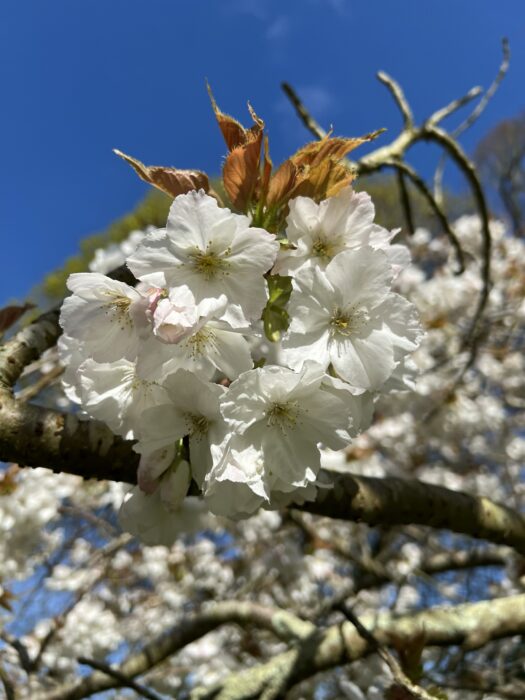
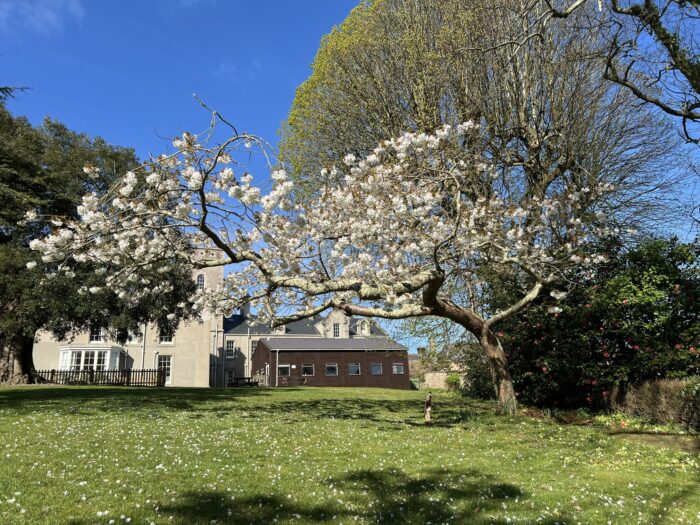
The most spectacular specimen, however, despite its lack of height, is surely the great white cherry (Prunus Tai-haku) in prime early spring foliage. Its bright white blossom is striking and impossible to miss.
‘Great’ refers to the size of these flowers, the largest of any cherry blossom. The tree itself is only around four metres tall but its canopy is wider. Tai-haku can reach up to eight metres in either direction, so width is standard. We don’t know this tree’s exact age but a 115 cm girth suggests at least fifty to sixty, meaning previous owner Col. Rupert Dawson planted it years before St George’s Preparatory School arrived in 1979.
The history of Tai-haku is remarkable, revolving around a character so knowledgeable that he earned the moniker “Cherry”.
Collingwood Ingram was born in 1880 in Kent into a family of politicians. After making his name as an ornithologist he served in World War I, before forging a career in horticulture.
By 1926 he had become an authority on Japanese cherries, even addressing Japan’s Cherry Society. While visiting, he was shown a picture of a white cherry believed to be long extinct. Ingram recognised it from a Sussex garden and reintroduced the cultivar to Japan in 1932, named Tai-haku.
Ingram went on to publish Ornamental Cherries in 1948. He died a centurion in 1981, likely satisfied with his achievements. He was certainly loved in Japan, where Naoko Abe’s tribute, ‘Cherry’ Ingram, was published in 2016.
Sakura is the Japanese term for cherry blossom and the trees are cultivars of Japanese cherry (P. serrulata) or Oshima cherry (P. speciosa). Great white cherry is part of an Oshima-based group of hybrids.
In Japanese tradition, sakura represents transience and contrast – new life, vibrancy and vitality, the fleeting nature of existence and beauty. It has been compared to the short lives of samurai and even painted on aircraft by kamikaze pilots. The annual Hanami (flower viewing) festival celebrates this ephemeral beauty.
Sakura’s etymology relates to harvest, with ‘sa’ meaning ‘rice paddy god’ and ‘kura’ meaning ‘seat for god’. The belief that gods inhabited these blossoms attracted worshippers. Standing next to a Tai-haku blossom, it’s easier to understand why.
Republished from the JEP, with its kind permnission