
The war in Iran is continuing to significantly impact Jersey’s farming and fishing communities as the cost of diesel surges even higher.
This week, the price hit 113.6 pence a litre, up from around 60 pence earlier this year. Meanwhile, white diesel sold on forecourts is now around £2 a litre, which is also risks seriously impacting the cost of doing business.
A much lower level of duty is charged by the government on the red diesel used by farmers and fishers. It is dyed red to prevent it being sold on the black market.
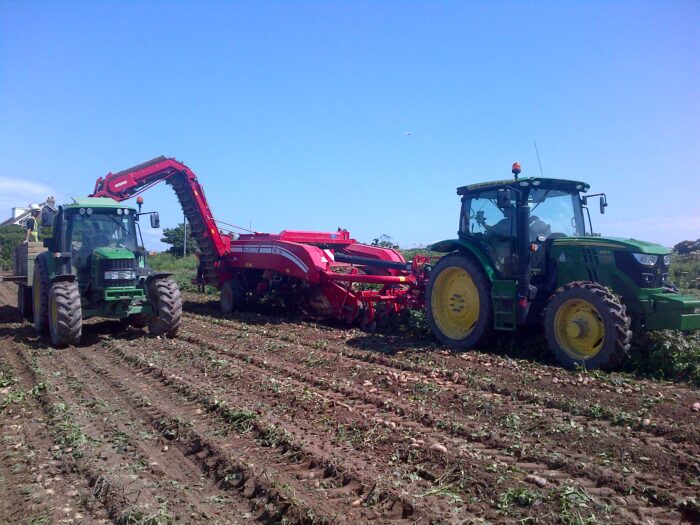
Jersey Royal Company director Mike Renouard said: ‘The price of red diesel is now just over a pound, almost double what it was earlier this year. That’s really important to us as it’s one of our biggest costs as we use it in our tractors.’
The steep rise in the cost of white diesel is also a significant concern, he added, because during the busiest times of the year Jersey Royal used about 40 minibuses to transport workers around the Island. The company farms around 5,300 vergées.
Mr Renouard explained that anything they used that required oil products had also gone up in price, including fertilisers and the rolls of plastic sheeting used to cover potato fields.
Autumn is a relatively quiet time of year for the potato industry, but things will be getting very busy when the planting season starts in January.
‘We hope that the fuel price will start coming down by then,’ he added.
Jersey Farmers’ Union president Dougie Richardson echoed the concerns.
‘The price has gone up significantly,’ he said. ‘It has risen to levels that make everything much more expensive. It’s very challenging as always.
‘I remember the fuel crisis when I was very young and my dad ploughing extremely shallow to save fuel. We cannot do that now. You have to plough at a good depth.’
Mr Richardson added: ‘It’s pretty much everything in the whole chain that has increased in cost right up to that last mile to the supermarket.’
He said that government should do what it could to alleviate the pressure.
‘When funds are needed to address an emergency, they need to be released. There is no point in farmers investing more in their businesses if they cannot afford to operate. It’s not just about the cost of new tractors, it’s the cost of the fuel you put in them,’ he said.
Earlier this year, the government pledged to continue supporting farmers and fishers, a promise honoured in the recent Budget proposal.
Introducing the 2027 Budget in September, Treasury Minister Senator Alan Maclean said: ‘This Budget continues the current level of funding from the Better Business Support package on a recurring basis to Jersey’s rural and marine sectors, in line with the States Assembly decision approved in March 2026. Funding will increase annually by RPI(X), providing long-term certainty for farmers and fishers to invest, improve productivity, and respond to market and cost pressures.”
In numerical terms, that means money available for the two limbs of the economy (as well as for measures to combat Violence Against Women and Girls, which is included in the same pot) will rise from £6,106,000 in 2027 to 9,223,000 in 2030.
The Rural Support Scheme gives out money and credits to farmers and smallholders to promote economic, environmental and social sustainability. Instead of just paying for basic crop or area production, the scheme rewards producers for delivering “public goods” and practising sustainable agriculture.
Mr Renouard said: ‘It’s good that the government has decided to support agriculture, and it is important that we keep getting that support’, adding that it should be emphasised that, while the Rural Support Scheme was invaluable, money available put Jersey farmers ‘right at the bottom of the league table’ in terms of funding per head of population compared to the UK.
In May, the then UK Chancellor announced that duty on red diesel would be reduced.
The change meant that the levy on red diesel was reduced from 10.18p a litre to 6.48p a litre from 15 June until the end of 2026.
Then Chancellor Rachel Reeves said: “I’m keeping taxes down for drivers and businesses – putting money in the pockets of millions of workers and cutting costs for farmers and hauliers.
“The war in Iran is pushing up fuel prices here at home, but after strong growth at the beginning of the year, I am stepping in to protect people at the pump.”