By RURAL magazine editor, Alasdair Crosby
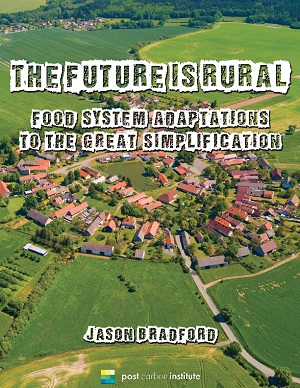
One day, several years ago – I think early in 2019 – my in-box brought me an e-mail with this encouraging title: The Future is Rural.
‘Excellent,’ I thought. ‘This is something about which I must urgently inform all the magazine’s advertisers.’
But within seconds my upbeat mood was tempered by the realisation that it was not, unfortunately, a reference to my own magazine, but to a publication from an American organisation called the Post Carbon Institute.
With the help of Mr Google, I quickly found the on-line promotional material for the publication. It is quite appropriate to quote from it in this present momnenbt of apprehension and unease about the future: ‘The Future is Rural challenges the conventional wisdom about the future of food in our modern, globalized world. It is a much-needed reality check that explains why certain trends we take for granted – like the decline of rural areas and the dependence of farming and the food system on fossil fuels – are historical anomalies that will reverse over the coming decades.
‘Renewable sources of energy must replace fossil fuels, but they will not power economies at the same scale as today. Priorities will profoundly shift, and food will become a central concern. Lessons learned from resilience science and alternatives to industrial agriculture provide a foundation for people to transition to more rural and locally focused lives.’
Thus, the book’s message is inspiring: we are all used to creeping urbanisation – in Jersey as elsewhere. All over the world, rural people move to urban areas, where they quickly lose connection to their roots and become part of a soulless cosmopolis.
But then, we saw several years ago in Greece during that country’s financial crisis, that city jobs disappeared, and urban dwellers realised that a city environment was no place to grow food or raise livestock. Many city folk returned to their native villages, where the land was a source of riches far more real and beneficial to daily sustenance than the chimera of financial information flashing on a computer screen.
As we jolt from crisis to crisis, where future shocks to our economy and our consumerised way of life can only be expected, there may indeed be a turning back to a more rural existence, closer to the life-giving earth.
This is also a theme of many writers. To quote Helena Norberg-Hodge, who has seen how the globalised food system has separated us from the sources of our food, thereby severing the land-based relationships that has informed our species’ entire evolution.
She writes: ‘But if food lies at the centre of the problem, it is also central to the solution. By transforming our food systems – by transitioning away from large-scale, industrial monocultures for centralised markets, towards diversified, smaller-scale place-based food production – we really can maximise productivity and feed the world, while simultaneously minimising resource use, healing ecosystems, and increasing the number of livelihoods…
‘By shortening the distance between the production and consumption of our basic needs, we stimulate diversified production, rebuild resilient economies in which wealth circulates locally, reweave the fabric of community that is the cornerstone of personal wellbeing, and enable communities to take back control over their own destiny. It is no wonder, then, that we are now witnessing an international resurgence of interest in community-based, sustainable farming.’
And so to RURAL (the magazine). In its first issue, the Spring of 2013, I wrote in its ‘Welcome page’: How can the best of Jersey’s traditional, local, rural community life be preserved so that it plays a continued vibrant part in the Island’s present and future?’
Still asking that, 50 editions and 12 years later!
The question, in its totality, is unanswerable, of course, even if part solutions can sometimes be glimpsed in the thickets of mundane events and day-to-day experience. But it is a question that continually deserves to be asked.
Many people throughout the world are asking the same question about the future of their own local home communities: how can their own local countryside, community, culture and heritage remain intact in today’s modern and globalised world?’
That should always be a theme to engage our attention in Jersey and be a subject for debate, lest by forgetting the local and the particular we lose a precious inheritance.
And by asking such questions, and by addressing possible solutions, we can help to ensure that, indeed, ‘the future is rural’.