By Alasdair Crosby
What are cover crops? You can’t eat them – not even the mustard (but it is a rather pretty plant, with a delicate yellow colour). So why bother planting them? As far as mustard is concerned, it suppresses weeds, breaks up soil compaction with its deep roots, adds organic matter, suppresses soil-borne diseases and pests, and grows fast. Ideal.
Much the same could be said for other common cover crops, like rye and barley, vetch and clover, or radish. They are selected based on their benefits, such as nitrogen fixation, erosion control, suppression of weeds or breaking pest cycles. Many farmers use a mixture of these types to combine all their benefits.
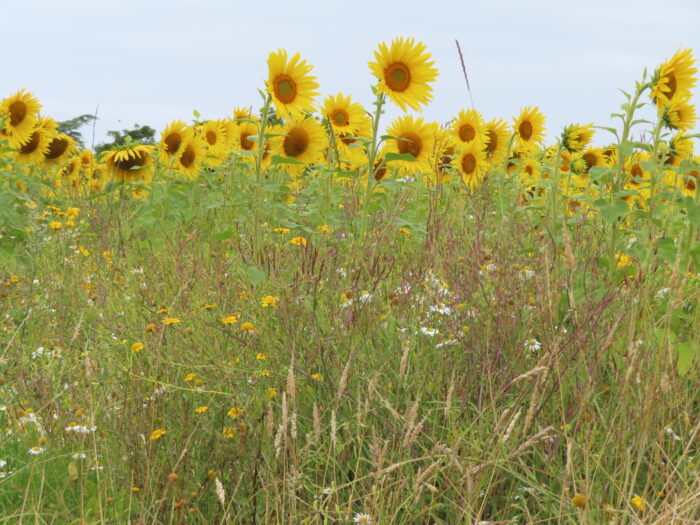
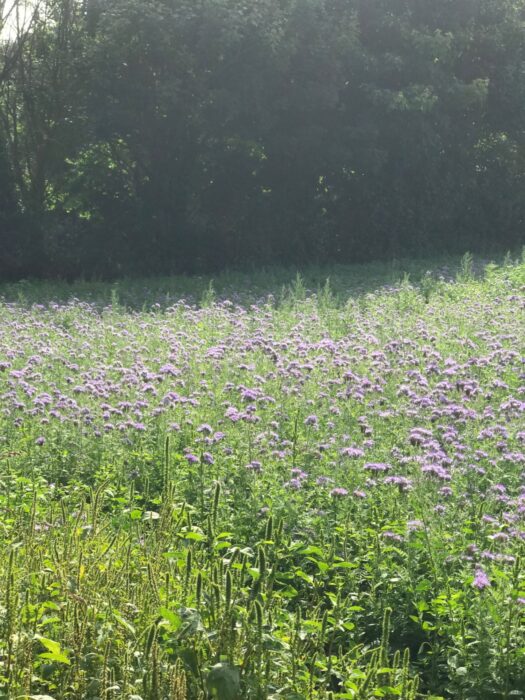
But cover crops are also for the birds. Think of the fields full of sunflowers that we can see around the Island in the late summer; when the crops die down, the seeds provide big-time avian attraction. Bees love phacelia.
So, in short, cover crops build a healthier, more resilient land. In agriculture, cover crops manage soil erosion, fertility, soil quality, water, weeds, pests, diseases, biodiversity and wildlife in an agroecosystem (an ecological system managed and shaped by humans) and can increase microbial activity in the soil, which has a positive effect on the natural environment.
So, cover crops can be summed up as ‘a jolly good thing’. At the recent Jersey Farmers’ Conference, Jersey’s cover crops showed their true colours as winners were announced of the annual cover crop competition that celebrates Jersey’s potato growers.
Now in its second year, this competition is run by the Jersey Royal Company (now a part of the Albert Bartlett company). It recognises the farmers who are leading the way in sustainable agriculture and whose efforts nurture the environment between potato growing seasons, helping to enhance soil structure, support pollinator habitats and boost biodiversity across the Island.
Tim Ward, the business unit director of the Jersey Royal Company, said: ‘Planting cover crops is something that farmers have always done in Jersey, more so than in parts of the UK that rely more on herbicides and chemical inputs. Because the potato crop is of such short duration, farmers have always looked for something to put into the land — grass, barley or whatever — to improve the soil and keep it in good order.
‘It’s about rotation, about adding to the quality of the soil. It’s a good thing to be involved with. And the competition is about recognition of the good work that farmers have always done and trying to encourage them to do more of it.
Hence the idea of these awards.’
Rotation of crops is hardly a new idea; farmers have always known that you cannot plant the same crops in the same land without giving the land a chance to rest. But with fewer Jersey Royals being planted these days, the area of fallow land is now somewhat greater, and provides more opportunity for planting cover crops that play an essential role in sustainable, regenerative farming. They do this by protecting and enriching the soil between harvesting and replanting seasons; helping to retain nutrients, preventing erosion, as well as offering vital food sources for pollinators and birds during quieter months. For Jersey Royal growers, they are an integral part of the cycle that keeps the Island’s landscape thriving.
This year’s competition was complemented by a research study led by Jersey freelance ecologist Jess Sandle-Brownlie, which examined the environmental impacts of cover crops on pollinators, soil health and bird diversity across Jersey. Using a method called ‘FIT counts’ (Flower-Insect Timed counts), Jess and the team gathered data from 108 sample sites across 35 fields, planted with four different mixes – bird, pollinator, soil, and grass ( as a control).
The key findings included the facts that cover crops produced six times as many pollinators per count compared to grass control fields. The three mixes were used and these showed equally positive effects on pollinator populations and diversity. Biodiversity and abundance both rose sharply wherever flowering crops were established and the presence of flowering plants contributed to overall ecosystem health.
‘Native cover crops of any type deliver tangible benefits to Jersey’s local biodiversity,’ the research study stated, and it concluded that cover cropping was one of the simplest and most effective ways that growers can promote wildlife diversity and soil regeneration, while at the same time supporting the long-term sustainability of the Island’s agriculture.
This year, the project has expanded beyond the fields. The Jersey Royal Company provided local primary and secondary schools tailored cover crop education materials designed for classroom use. These materials were used to teach pupils the importance of cover crops, why we use them and understand how biodiversity supports food production.
‘By sowing both seeds and curiosity, we hope to inspire the next generation of Jersey farmers, scientists, and environmental stewards,’ Tim said. ‘We try to give them some insight into the countryside, for example, why sunflowers are planted and what they are supposed to do. We hope it might open their minds a bit and show them that farming is not just about tractors and potatoes — it’s all about the natural environment and doing what’s right for the Island for the next generation.’
The 2025 competition was made possible by a host of supporters sharing a common concern for the countryside: the Environment Department, Jersey Dairy, Birds on the Edge, the Howard Davis Farm Trust, Normans, Pollinators Project, Grow – Thrive Jersey, the Jersey Beekeepers Association, the National Trust for Jersey and, of course, the growers and Jersey Royal producers themselves.
‘They each brought their own expertise,’ Tim said. ‘We work closely with Birds on the Edge, for example, who make sure there is something there for over-wintering birds. Tina Hull from the Environment Department, and Dawn Venton from Normans were two of the judges, and showed they could name almost every variety of grass, weed or plant that we saw.
‘The fields are inspected twice throughout the year to select what the judges think is the best field. I found it really inspirational, going into a field, and seeing the colour, the diversity, butterflies, bees, the wasps.
‘What made it interesting was our wide a cross-section of judges. For example, we might suggest that a particular field that had provided a lovely array of sunflowers was now past its best and dying off, but Cris Sellarés from Birds on the Edge would tell us “No, this is a really good field, the best field I’ve seen so far, because the seeds that have fallen provide a banquet for the bird.” She also noted the size of the seeds relative to the size of the beaks; different bird species have different beak sizes, of course, so they will only go for certain seeds.’
At the time of writing, there is still some colour about in the fields, especially phacelia, blue flowers that are one of the most attractive flowers for pollinators.
It has to be said that this year judging was difficult because it has been a difficult and dry summer, with drought conditions, making it difficult for some of the crops to get established.
‘We were judging at similar times to last year, and the results were quite disappointing. In the summer, crops were up to knee height, whereas last year we were up to our waist. It was better in October, when there had been enough rain and they had all sprung up.’
The overall winner of the competition was Meleches Farm, the Island’s largest independent grower of Jersey Royal potatoes, owned and run by fifth generation farmer Nick Mourant, for fields at Le Catelet, St John.
‘Nick had made significant investment with cover crop as far as the eye could see,’ Tim said. ‘The species range was excellent, with a good range of flower, height, shape, colour and flowering time. It looked superb, was alive with pollinators and will be a good food source over the winter for a variety of fauna.’
He added: ‘We would like to increase and widen the competition in future years. It’s right for the fields, right for soil health and right for the Island.’
Category Winners – Cover Crop Competition 2025
• Best Pollinator Mix Field – Meleches Farms (Nick Mourant)
• Best Bird Mix Field – Fosse au Bois (Paul, Peter and Matt Carré)
• Best Soil Health Mix Field – Jersey Royal Company Blue Team (Adrian Baudains and Joe Martins)
• Best Visual – Master Farms (Peter, Phil and & Phil Jnr Le Maistre)
• Overall Winner 2025 – Meleches Farms (Nick Mourant)
This article first appeared in the Jersey Evening Post and is republished here by their kind permission